Key takeaways
- Thirteen of 148 tied a closing or payment interval to agreement. Ten tied one to a later milestone. The later group includes a deadline after title verification, a signed deed, completed paperwork or closing. This was measured among 148 public-directory buyer and intermediary websites read October 8, 2026.
- Fifty-three of 148 sites had both offer-stage and closing-stage timing language. The original timing codes include qualitative language, so a site can appear in this count without giving two numeric intervals. This was measured among 148 public-directory buyer and intermediary websites read October 8, 2026.
- At least 32 of the 90 explicit closing-field entries lacked a comparable closing or payment interval in the tracked statement. Those cases include quickness claims, component timelines and time to sign a contract. Other entries can still omit a clear start date. This was measured among 148 public-directory buyer and intermediary websites read October 8, 2026.

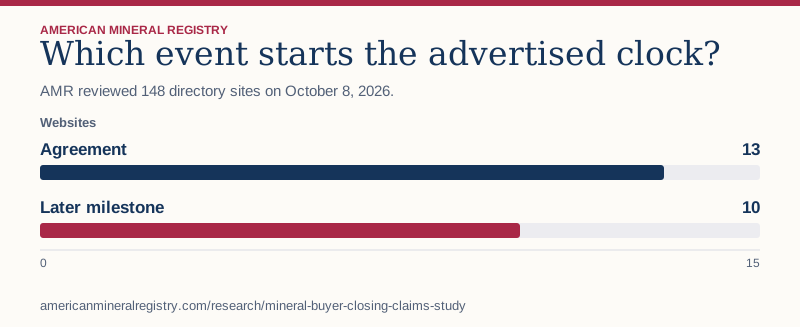
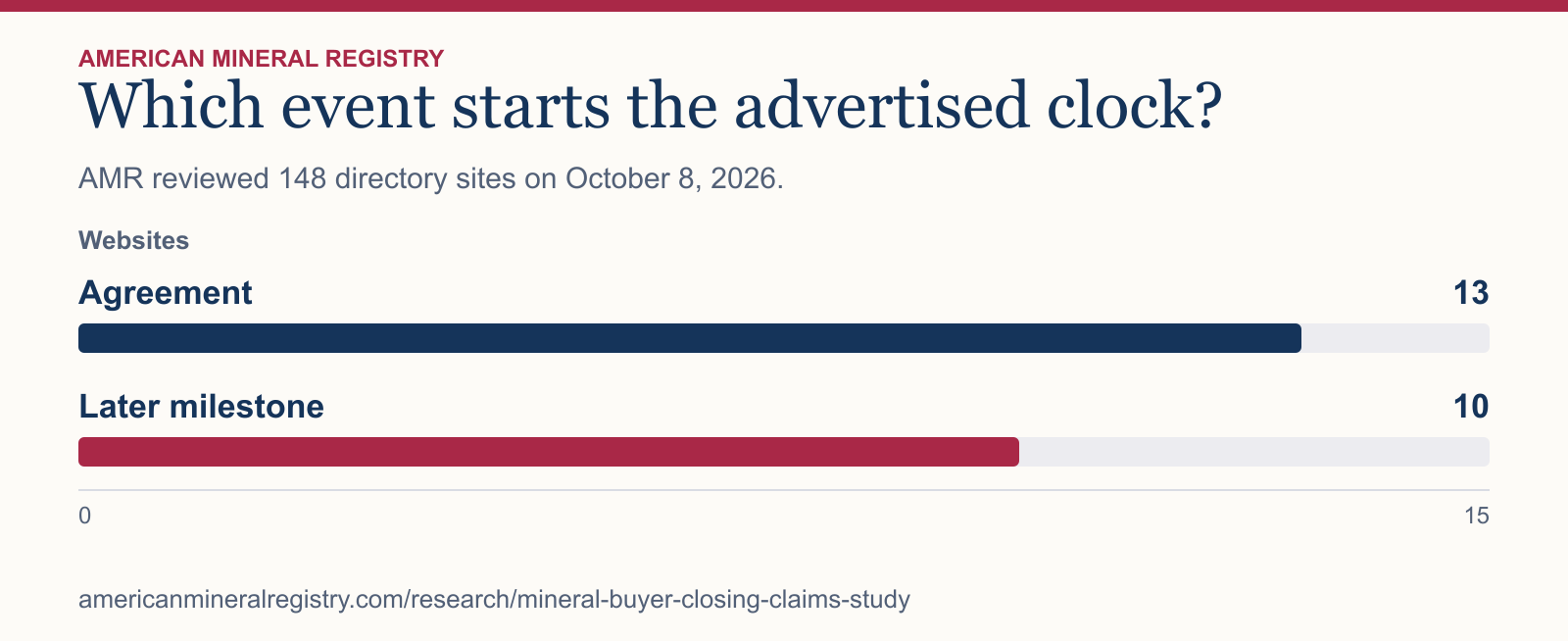
Figure 1 in text
AMR reviewed 148 directory sites on October 8, 2026. Websites.
| Category | Websites |
|---|---|
| Agreement | 13 |
| Later milestone | 10 |
Chart wording and scale
Which event starts the advertised clock? AMR reviewed 148 directory sites on October 8, 2026.
Websites
Agreement
13
Later milestone
10 0 15
Source and data: Download chart source data
Permanent link to this figure’s text and data · Sources and context
When does the advertised clock begin?
AMR found 13 agreement-based clocks and 10 later-stage clocks in its October 8, 2026 review of 148 directory-listed websites. An acceptance or signed-contract clock can run during title review. A clock that begins once the title is cleared or the signed deed is in hand usually leaves those earlier steps outside the interval.
Two sites in that sample tied an interval to contact or consultation. One of those also gave a later payment window. Counting the clock types separately preserves both statements without treating them as independent deals.
Is a fast offer the same as a fast payment?
Among the 148 websites read October 8, 2026, 70 had explicit offer-stage language, 90 had explicit closing-stage language, and 53 had both. The offer-stage field can include a response, evaluation or auction window. The closing-stage field can include a time to close, a payment window or qualitative speed language.
- Ask for the day the buyer considers your file complete.
- Ask when the advertised interval ends: signed agreement, deed recording, funds sent, or funds received.
- Identify which step has a stated deadline and whether that deadline depends on title or documents.
What does a clock tied to a deed leave out?
One site gave a period of 10 to 15 business days after receipt of the signed deed or assignment. Another described payment the next business day after receiving signed documents. Each statement describes time after a paperwork milestone. The time to get the paperwork ready sits outside that clock.
Qualifiers such as typically, as little as and subject to title affect what a published window means. A shortest case, an advertised average and an outside deadline answer different questions.
Can I use these claims to estimate an average closing time?
The public ledger measures what sites said. The observations have different clocks, different conditions, and no completed-sale dates. A useful comparison keeps the start, finish, units and contingencies together rather than pooling all advertised day counts into an average.
Guide to the stages of a mineral rights sale
How were the milestone counts verified?
AMR kept the original closing and offer labels from all 148 directory records read October 8, 2026. It manually separated recorded intervals that start at agreement, at a later title or paperwork milestone, or at contact. Generic claims, component clocks and time to sign a contract were kept apart when the tracked text supplied no overall close or payment interval. Site wording can change after the archived date.
Sources and data
- AMR buyer disclosure ledger, October 8, 2026
- Mineral Buyer Transparency Report and sampling method
- Payment window after signed deed or assignment
- Payment after receipt of signed documents
- Acceptance-to-payment timing example
Download the data (CSV) · Read the data dictionary. The AMR analysis and figures are licensed CC BY 4.0. Refer to the original issuers for their materials.